
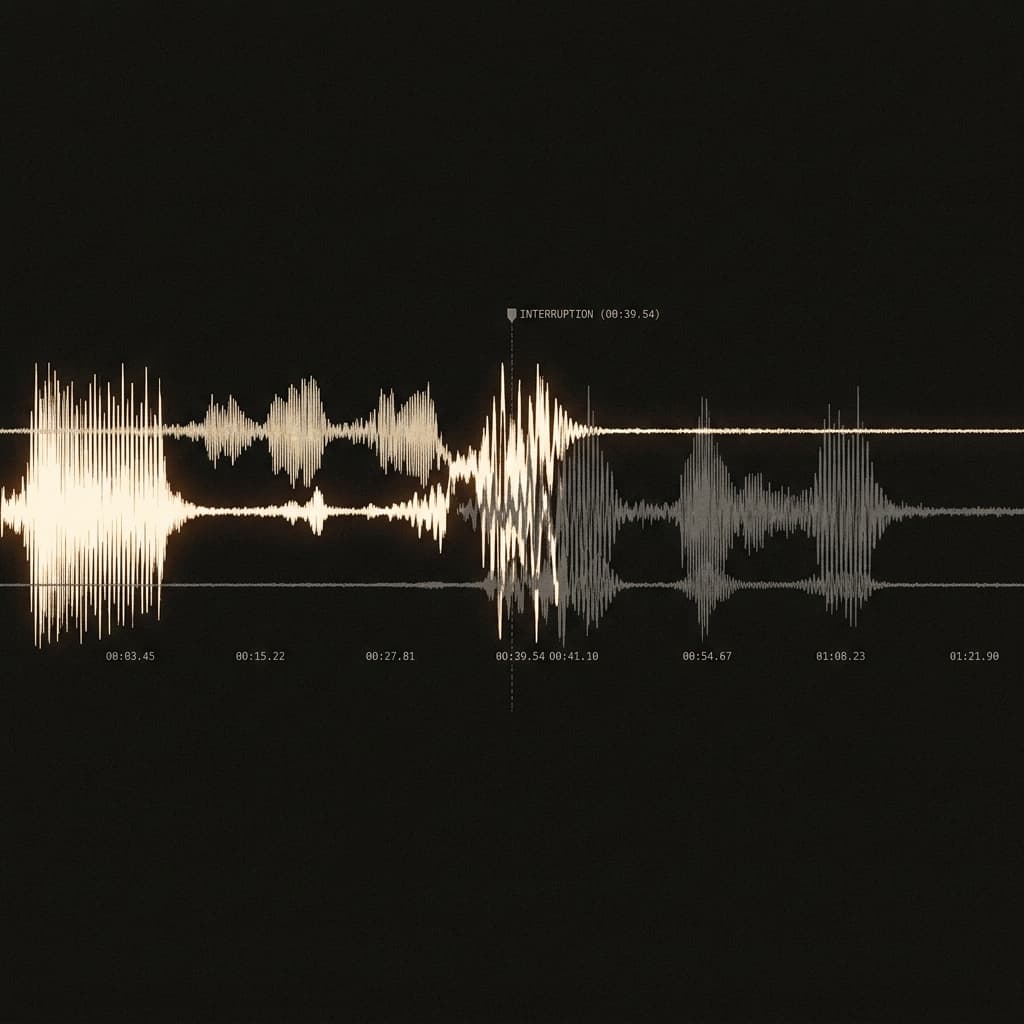
The Sequential Problem
Traditional Voice AI operates on a strictly sequential state machine.
- Listen: Record audio until silence is detected.
- Process: Send to STT (Speech-to-Text), then LLM, then TTS (Text-to-Speech).
- Speak: Play the audio response.
- Repeat.
This creates the dreaded "walkie-talkie" effect. If the AI is speaking, the human cannot interrupt. If the human pauses to think ("umm..."), the AI assumes they are finished and cuts them off. It forces the human to adapt to the machine's strict HTTP request/response cycle.
The Asynchronous Engine
To achieve human-like fluidity, we had to break the sequential state machine. We rebuilt the VSIP core architecture around asynchronous, full-duplex audio streams.
Instead of waiting for a complete utterance, the system streams audio continuously to the edge processor via WebSockets.
- Continuous Listening: The microphone never turns off. Even while the AI is speaking, it is analyzing the user's audio channel.
- Interruption Handlers: If the user speaks a clear linguistic token while the AI is talking, the AI instantly halts its playback and flushes its current audio buffer.
- Backchanneling: If the user says "uh-huh" or "yeah," the system classifies it as a backchannel token. It acknowledges the user is engaged but does not interrupt the AI's playback.
Designing for Intent, Not Just Silence
The hardest part of conversational AI isn't understanding words; it's understanding silence.
In a traditional system, 1.5 seconds of silence triggers the end of a turn. But humans pause for many reasons: to read a screen, to look in their bag, or simply to think.
We introduced Multimodal Intent Analysis.
By coupling the audio stream with the kiosk's vision sensors, we analyze user gaze and posture during silences.
- If the user is looking away or down, the system extends the silence threshold (they are thinking/searching).
- If the user makes direct eye contact with the screen and closes their mouth, the system shortens the threshold (they are yielding the floor).
We stopped measuring silence in milliseconds and started measuring it in intent.
The End of the Walkie-Talkie
The result is a kiosk that doesn't feel like a command-line interface wrapped in a voice wrapper. It feels like a conversation.
- Sub-150ms Interruption Latency: The AI stops speaking almost instantly when interrupted, preventing frustrating overlap.
- Zero "Cut-Off" Complaints: By using gaze-aware silence thresholds, users are no longer cut off while thinking.
- 3x Increase in Session Length: Users engage in longer, more complex diagnostic conversations because the cognitive load of "operating" the AI has been removed.
The Three Tier engineered the latency out of the conversation, allowing the intelligence of the LLM to actually shine through.